

Hard of Hearing
July 08, 2026 Noticing a change in your hearing, or watching a loved one struggle to catch every word of a conversation, can feel overwhelming. Hearing connects us to the people we love, the music we enjoy, and the environment around us. Acknowledging that you or someone close to you might be hard of hearing is a courageous first step—and we are right here beside you on this journey.
The journey to better hearing starts with understanding. Hearing loss is an incredibly common health concern, and it does not have to mean a permanent change in your lifestyle. By learning about how our ears process sound, recognizing the early signs of hearing changes, and exploring the available solutions, you can confidently take control of your hearing health. Whether you are experiencing unclear speech in crowded rooms or simply want to learn more about the terminology and causes associated with hearing loss, this guide will provide the clarity and reassurance you need to navigate your next steps.

What Does It Mean to Be Hard of Hearing?
The term "hard of hearing" refers to a spectrum of hearing loss that ranges from mild to severe. People who are hard of hearing generally communicate through spoken language and typically have some degree of usable hearing. They often benefit significantly from hearing devices, communication strategies, and other assistive technologies to help them stay connected to their world.
It is helpful to understand how this term differs from others you might hear, particularly "deaf" or "deafness." While "hard of hearing" implies a partial loss of hearing, "deaf" usually describes a profound hearing loss where individuals have very little or no functional hearing. Many people who are deaf rely primarily on sign language for communication. Those who are hard of hearing, on the other hand, usually rely on residual hearing, reading lips, and hearing aids to understand spoken language.
Is "Hard of Hearing" the Correct Term?
Language evolves, and it is entirely normal to wonder what words are respectful and appropriate to use. Today, "hard of hearing" is widely considered the correct, proper, and most respectful term to describe someone with mild to severe hearing loss.
In the past, the term "hearing impaired" was frequently used in medical and educational settings. However, many individuals and advocacy groups—including the American Speech-Language-Hearing Association—now discourage the use of "hearing impaired" because the word "impaired" focuses on what is broken or deficient rather than focusing on the person. Saying someone is "hard of hearing" is neutral, accurate, and preferred by the community.
Degrees of Hearing Loss
Hearing loss is not a single, uniform condition. It occurs on a sliding scale, usually measured in decibels (dB). Depending on how many decibels of sound you are missing, your hearing care partner might categorize your hearing loss into one of the following degrees:
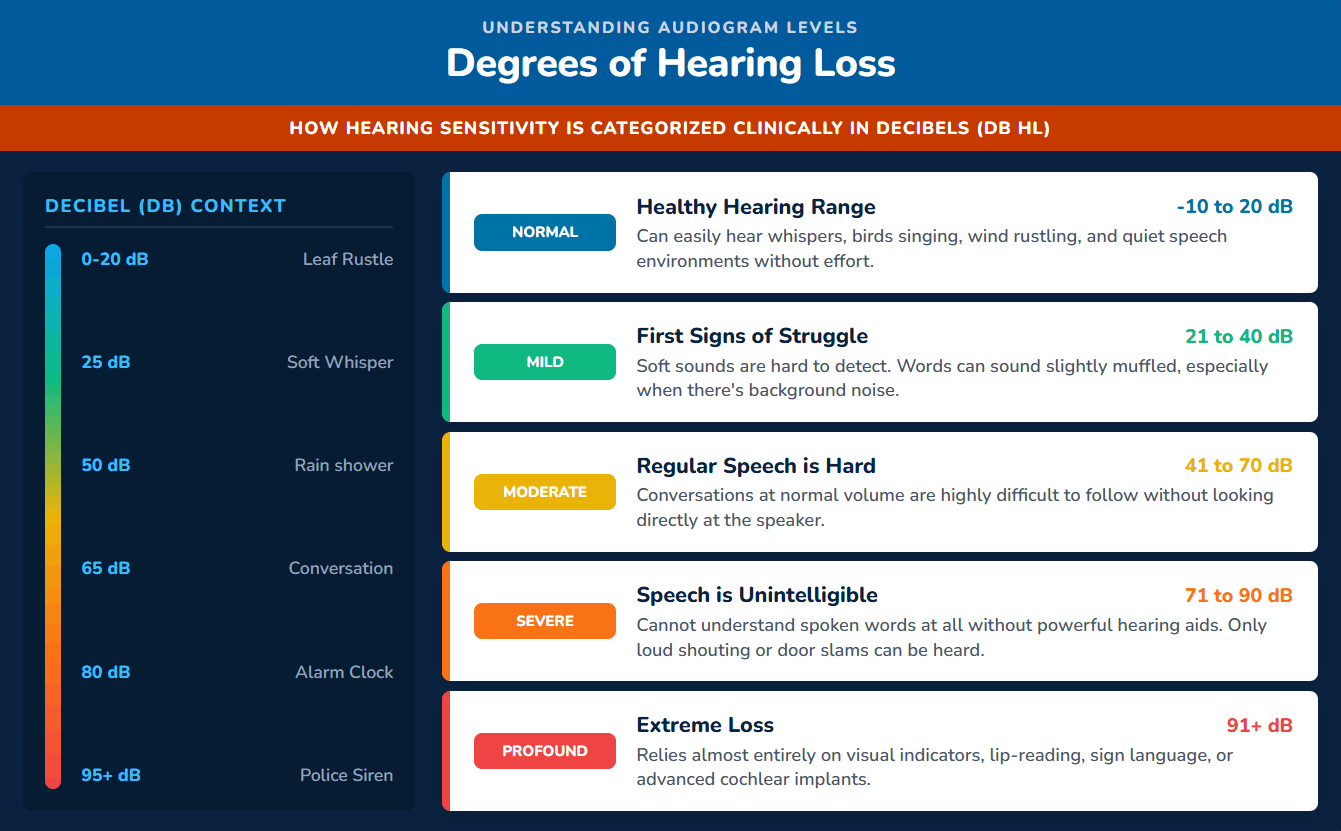
- Mild Hearing Loss: You might struggle to hear soft sounds, such as rustling leaves, ticking clocks, or whispered conversations. In quiet environments, communication is usually fine, but background noise makes it difficult to understand speech.
- Moderate Hearing Loss: Normal conversational speech becomes difficult to hear, even at a close distance. You might frequently ask other people to repeat themselves or need to turn the television up to a volume that others find too loud.
- Severe Hearing Loss: Without the assistance of hearing aids, you would not be able to hear conversational speech at all. You might only be able to hear loud noises, such as a dog barking closely or a vacuum cleaner.
- Profound Hearing Loss: This level is often referred to as deafness. Individuals with profound hearing loss can only hear very loud sounds, like a passing siren or a loud airplane, and may rely heavily on visual cues or sign language.
Understanding the Anatomy of Hearing
To understand why someone becomes hard of hearing, it helps to understand how the ear works. Hearing is a complex, beautiful process that translates invisible sound waves in the air into meaningful information in your brain.
The ear is divided into three main sections: the outer ear, the middle ear, and the inner ear. Sound waves first enter the outer ear and travel down the ear canal until they strike the eardrum. The eardrum vibrates from this sound pressure, sending movements through three tiny bones in the middle ear. These bones amplify the sound and send it into the inner ear, specifically to a snail-shaped organ called the cochlea. The cochlea is filled with fluid and lined with thousands of microscopic hair cells. As the fluid moves, these hair cells bend, converting the physical vibrations into electrical signals. The auditory nerve then carries these signals to the brain, where they are finally interpreted as recognized sounds, like a grandchild laughing or your favorite song playing.

Types and Causes of Hearing Loss
When a breakdown occurs anywhere along this auditory pathway, the result is hearing loss. The specific location of the breakdown determines the type of hearing loss you have.
Sensorineural Hearing Loss (Inner Ear)
Sensorineural hearing loss is by far the most common type of hearing loss among adults. It happens when there is damage to the delicate hair cells inside the cochlea or the auditory nerve itself. Once these hair cells are damaged, they cannot regrow or repair themselves. Because this type involves the inner ear and nerve pathways, the appropriate solution is almost always the use of hearing aids.
Common causes of sensorineural hearing loss include:
- The Natural Aging Process: As we grow older, the hair cells in our inner ear naturally begin to wear down. This gradual progression often makes high-pitched sounds and consonant letters (like S, F, and Th) difficult to hear, resulting in unclear speech.
- Exposure to Loud Noise: Whether from years of working in a loud factory, operating power tools, attending loud concerts, or listening to headphones at maximum volume, prolonged exposure to loud sounds is a major common cause of inner ear damage.
- Tinnitus: While not a cause of hearing loss, tinnitus (a ringing, buzzing, or roaring sound in the ears) frequently accompanies sensorineural hearing loss.
- Congenital Factors and Illness: In some cases, children are born with hearing loss due to congenital factors or prenatal infections such as rubella or cytomegalovirus.
Conductive Hearing Loss (Outer or Middle Ear)
Conductive hearing loss occurs when sound is physically blocked from passing through the outer or middle ear into the inner ear. Unlike sensorineural hearing loss, conductive hearing loss can often be treated medically or surgically.
Common causes of conductive hearing loss include:
- Earwax Buildup: A simple blockage of earwax in the ear canal can significantly muffle incoming sound.
- Ear Infections: Conditions like otitis media (an infection of the middle ear) cause fluid to build up behind the eardrum. This is particularly common in young children and temporarily stops the eardrum from vibrating properly.
- Physical Damage: A punctured eardrum or problems with the tiny bones in the middle ear can prevent sound waves from being conducted inward.
Quick Self-Check: Could You Be Hard of Hearing?
Answer 6 simple questions to help you understand your hearing health.
1. Do you often feel like people around you are mumbling or speaking unclearly?
Question 1 of 6
Early Signs You Might Be Hard of Hearing
Because age-related and noise-induced hearing loss usually develop slowly over time, you might not notice the changes right away. Often, family members or close friends are the first to observe the signs. Acknowledging these signs is a positive step toward taking back your desired lifestyle.
- You frequently feel like other people are mumbling or speaking with unclear speech.
- You find it exhausting to participate in group conversations or follow along in noisy environments like restaurants or family gatherings.
- You regularly need to ask people to repeat themselves.
- You find yourself turning up the volume on the television or radio to a level that is uncomfortable for others.
- You experience a ringing or buzzing sound in your ears.
- You avoid social situations or find yourself withdrawing from conversations because the effort required to listen is simply too draining.
It is worth noting that if your hearing suddenly becomes muffled in one ear—even for just a few seconds or hours—it could be a sign of a temporary blockage like earwax, pressure changes, or fluid. However, sudden hearing loss can also require prompt medical attention. If you experience a sudden and persistent drop in your hearing, it is wise to consult a healthcare professional immediately.

Next Steps: Assessments and Hearing Solutions
If you suspect that you or a loved one is hard of hearing, you do not have to navigate the journey alone. Seeking support is the best way to regain confidence and ensure that hearing loss does not become a permanent obstacle to enjoying life.
Taking a Hearing Test
The very first step is to schedule a professional hearing test or hearing assessment. This evaluation is simple, completely painless, and highly informative. During a test, a hearing care professional or audiologist will look inside your ears to check for physical blockages like earwax. Then, you will listen to a series of tones at different pitches and volumes through a pair of headphones. The results are plotted on a graph called an audiogram, which visually maps exactly what sounds you can and cannot hear.
Exploring Hearing Aids
If your hearing assessment reveals that you are hard of hearing, a dedicated hearing care partner can help you find a hearing solution tailored to your unique lifestyle. Today's hearing aids are remarkably advanced, discreet, and incredibly comfortable—designed to seamlessly integrate into your daily life.
Modern hearing technology focuses on providing you with clear, natural sound so you can confidently rejoin the conversation. Many options are weatherproof, meaning you can spend more time outdoors with friends and family and less time worrying about moisture or dust. Contemporary hearing aids often feature wireless connectivity, allowing you to stream phone calls, podcasts, music, and more from your compatible smartphone directly to your hearing aids. For those with profound hearing loss where traditional hearing aids may not provide enough benefit, a cochlear implant might be considered—a surgical option that bypasses damaged portions of the ear and directly stimulates the auditory nerve.
Strategies for Better Communication
Technology is only one part of the solution. When someone in your life is hard of hearing, adjusting how you communicate can ease frustration and build stronger connections.
Tips for those communicating with someone who is hard of hearing:
- Get their attention first: Say their name or gently tap their shoulder before you begin speaking so they are prepared to listen.
- Face them directly: Visual cues are incredibly important. Keep your mouth visible so they can read your lips and facial expressions.
- Speak clearly, but do not shout: Shouting distorts the shape of your mouth and the sound of your voice. Speak at a normal, steady pace and enunciate your words clearly.
- Reduce background noise: Whenever possible, turn down the television or move away from loud appliances before starting a conversation.
Tips for individuals who are hard of hearing:
- Advocate for yourself: Do not be afraid to tell people what you need. A simple phrase like, "I have a little trouble hearing, could you please face me when you speak?" can make a world of difference.
- Position yourself well: In a restaurant or meeting, sit with your back to the primary source of noise so that the voices you want to hear are in front of you.
- Give yourself grace: Experiencing hearing loss can take an emotional toll. Be patient with yourself as you adapt to new communication habits and hearing technology.
Ready to Take the Next Step?
If you suspect you or a loved one is hard of hearing, a professional hearing assessment is the first step toward clarity and confidence. Your hearing care partner is ready to guide you through every step—from your first test to finding the right solution for your lifestyle.
Schedule a hearing appointment today and take the first step toward staying connected to the sounds and people you love.
Frequently Asked Questions (FAQ)
This article is for informational purposes only and does not constitute medical advice. If you have questions about your hearing health or hearing solutions, consult your hearing care provider.

Online Hearing Assessment
