

Hearing Aid vs Hearing Amplifier: What’s the Difference?
June 26, 2026 Changes in your hearing can feel overwhelming, especially when conversations, TV, or social outings become harder to follow. If you are comparing devices, you will usually see two options: hearing aids and hearing amplifiers. Understanding the difference is an important first step toward choosing the right support for your hearing, daily routine, and connection with others.
Although hearing aids and hearing amplifiers can look similar, they are designed for entirely different needs and use very different technology. This guide will walk you through exactly how they compare, so you can feel confident in the decision that best supports your hearing health.

Summary of Key Terms
Before exploring the details of how these devices compare, it is helpful to understand the basic terminology used to describe hearing technology.
- Hearing Aid: A sophisticated, FDA-regulated medical device specifically designed to treat hearing loss. These devices are customized to an individual's unique hearing profile, amplifying specific sound frequencies while managing background noise.
- Hearing Amplifier: Also known as a Personal Sound Amplification Product (PSAP), this is a wearable electronic device designed to make all environmental sounds louder for people with normal hearing. They are not regulated as medical devices and are not intended to treat hearing loss.
- Over-the-Counter (OTC) Hearing Aid: A category of hearing aids available without a prescription, intended only for adults with perceived mild to moderate hearing loss.
- Prescription Hearing Aid: A hearing device programmed and fitted by a professional based on a comprehensive hearing evaluation, capable of treating all levels of hearing loss, from mild to severe.
- Hearing Care Professional: A trained specialist, such as an audiologist or hearing instrument specialist, who evaluates hearing health, recommends appropriate solutions, and provides ongoing support and device adjustments.
- Background Noise: Ambient sounds in an environment, such as the clinking of dishes in a restaurant or the hum of an air conditioner, which can interfere with understanding speech.
What Is a Hearing Amplifier?
A hearing amplifier, formally categorized as a Personal Sound Amplification Product (PSAP), is a relatively simple electronic device designed to amplify environmental sound. The most important thing to understand about a hearing amplifier is that it is meant for individuals who already have normal hearing but want to make sounds louder in specific, targeted situations.
The technology inside a standard hearing amplifier works like a basic volume control knob. When you turn it on, the device collects the sound in your environment and makes everything louder by the exact same amount. If you are sitting in a quiet forest trying to listen to a distant bird call, a hearing amplifier can be quite useful. Other common uses for these devices include listening to a distant speaker at a quiet lecture hall or participating in recreational activities where enhancing distant sounds is beneficial.
However, because hearing amplifiers boost all sounds equally, they do not differentiate between the sounds you want to hear and the sounds you want to ignore. If you are wearing a personal amplifier in a busy restaurant, it will amplify the voice of the person sitting across from you, but it will also equally amplify the clattering of silverware, the music playing overhead, and the traffic outside. For someone experiencing hearing loss, this universal amplification usually leads to frustration.
What Is a Hearing Aid?
A hearing aid is a complex, highly advanced medical device designed specifically to compensate for hearing loss. Unlike a basic amplifier that simply makes everything louder, a modern hearing aid acts as a miniature, sophisticated computer for your ear.
When a person experiences hearing loss, they rarely lose the ability to hear all sounds equally. Most often, people lose the ability to hear specific frequencies—usually higher-pitched sounds like the voices of women and children, or the crisp consonant sounds in speech, such as "s," "f," and "t." A hearing aid is programmed to match your exact hearing profile, selectively amplifying only the specific frequencies you have difficulty hearing, rather than just turning up the volume on the entire world.
Furthermore, hearing aids are designed to help you navigate complex listening environments. They continuously scan your surroundings and automatically adjust to prioritize human speech while suppressing unwanted background noise. This selective processing helps reduce the listening fatigue that so often accompanies hearing loss.
Modern hearing aids also include features designed to seamlessly integrate into your lifestyle. Many are weatherproof, meaning you can spend more time outdoors gardening, golfing, or walking with family without worrying about moisture or dust damaging your devices. They also frequently offer streaming capabilities, allowing you to route phone calls, audiobooks, and music directly from your compatible smartphone into your hearing aids.
Hearing Aids vs Hearing Amplifier: Key Differences
When comparing hearing aids vs hearing amplifiers, the distinctions go far beyond price and availability. The differences lie in their fundamental purpose, how they process sound, how they fit physically, and the level of support that accompanies them.
Sound Processing and Clarity
The most significant difference is how the devices manage sound. A hearing amplifier uses linear amplification, meaning it raises the volume of all sounds equally. If you are struggling to hear a conversation in a noisy environment, an amplifier will simply make the entire noisy environment louder.
A hearing aid uses non-linear, digital sound processing. It analyzes the incoming sound, identifies which sounds are speech and which are noise, and makes split-second adjustments. It will elevate the soft speech sounds you need to hear while actively dampening the loud background noise you do not want to hear. This sophisticated processing is what allows people with hearing loss to confidently rejoin conversations in challenging environments like family gatherings or busy cafes.
Customization to Your Unique Needs
Hearing loss is entirely unique to the individual. A hearing amplifier is a one-size-fits-all product—it cannot be adjusted to treat your specific pattern of hearing loss.
In contrast, prescription hearing aids are intricately customized. A hearing care professional uses the results of your hearing test to program the device to your precise needs. If your hearing changes over time, the hearing aid can be reprogrammed to accommodate those changes, ensuring you continue to get the right level of support year after year.
Fit, Comfort, and Device Care
Comfort is vital when choosing a device you may wear for most of your waking hours. Hearing amplifiers generally come with generic earpieces that may or may not fit the unique shape of your ear canal securely.
Hearing aids are selected and fitted based on the specific anatomy of your outer ear and ear canal. Whether you choose a style that sits behind the ear or one that rests completely in the canal, the physical fit is tailored to ensure the device stays secure and comfortable throughout the day. Your hearing care partner will also guide you on proper device care, showing you step-by-step how to clean your devices, manage batteries or charging stations, and troubleshoot minor issues.
Professional Partnership and Support
Purchasing a hearing amplifier is a standalone transaction. You buy the device, and you are left to figure out how to use it on your own.
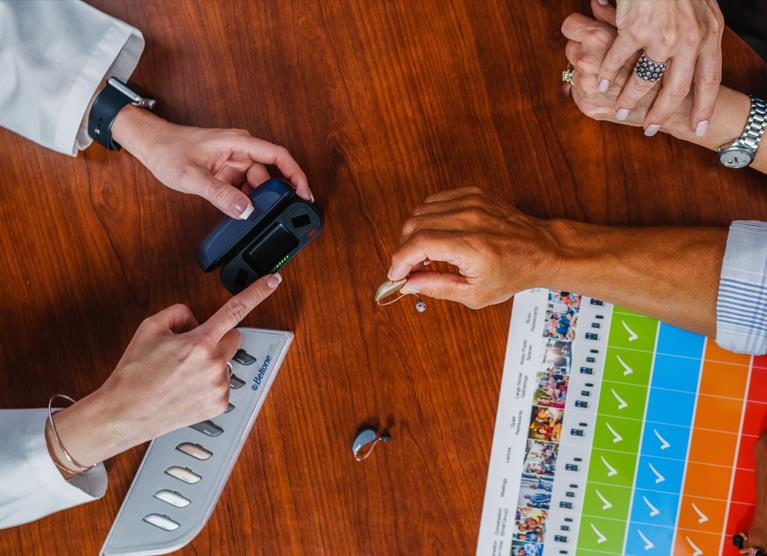
When you choose a prescription hearing aid, you are also choosing a hearing health partner. Your hearing care professional will be beside you on your journey to better hearing. They provide guidance on what to expect during your initial trial period, help you set realistic expectations for your adjustment timeline, and schedule follow-up visits to fine-tune your devices as your brain relearns how to process certain sounds.
Should I Get Hearing Aids? Signs It's Time to Seek Help
A common question people ask is, "Should I get hearing aids, or can I just use an amplifier for now?" Because hearing loss often occurs gradually, it can be difficult to recognize when it is time to seek professional help.
If you find yourself relating to any of the following scenarios, it is likely time to consider scheduling a comprehensive hearing evaluation rather than relying on a general sound amplifier:
- You feel exhausted after socializing: Listening with untreated hearing loss requires a tremendous amount of cognitive energy. If you feel drained after a dinner party or family gathering because you had to concentrate so hard to follow the conversation, a hearing aid can help ease that burden.
- You have trouble in background noise: If you can hear fine one-on-one in a quiet room but struggle to understand the server at a restaurant or your grandchildren playing in a busy room, you need the advanced noise-filtering technology of a hearing aid, not the universal volume boost of an amplifier.
- Family members comment on the television volume: If your spouse or loved ones frequently mention that the TV or radio is uncomfortably loud for them, but it sounds normal to you, this is a common indicator of high-frequency hearing loss.
- You frequently ask people to repeat themselves: If it sounds like people are mumbling, or you find yourself relying heavily on reading lips to understand what is being said, your ears are likely missing the clarifying consonant sounds that hearing aids are designed to restore.
Adjusting to hearing aids is a process. When you first begin wearing them, your brain will need time to adapt to hearing sounds it may not have heard clearly in years—like the rustling of newspaper, the hum of the refrigerator, or the ticking of a clock. A hearing care professional will explain this adjustment timeline, normalizing these experiences and providing the support you need as you navigate this transition.

Next Steps: Moving Forward With Confidence
Experiencing hearing loss does not have to mean a permanent change in your lifestyle. With the right tools and the right support, it is a solvable issue. You do not have to stop going to your favorite noisy restaurants, and you do not have to feel isolated during family gatherings.
If you suspect you are experiencing hearing loss, the most empowering first step you can take is to schedule a hearing test with a professional. They will help you understand your unique hearing profile and guide you toward a solution that works best for your daily life.
Ready to Take the Next Step?
By choosing a device designed specifically for your needs, you give yourself the tools to confidently return to the activities you love, staying connected to your family, friends, and the world around you. Your hearing care partner is ready to guide you every step of the way.
Schedule a hearing appointment today and take the first step toward staying connected to the sounds and people you love.
Frequently Asked Questions (FAQ)
This article is for informational purposes only and does not constitute medical advice. If you have questions about your hearing health or hearing solutions, consult your hearing care provider.

Take Online Hearing Test
Take our free at-home hearing loss test as a first step on your journey to better hearing.
